

The Lahnwanderweg Stage 6

Stage 6 of the Lahnwanderweg takes us from Caldern into Marburg, and it was our first stage with a real legend attached. We started early on Sunday, February 27, 2022, which is exactly what the trail guide recommends: start early in Caldern so you can enjoy the afternoon in Marburg.

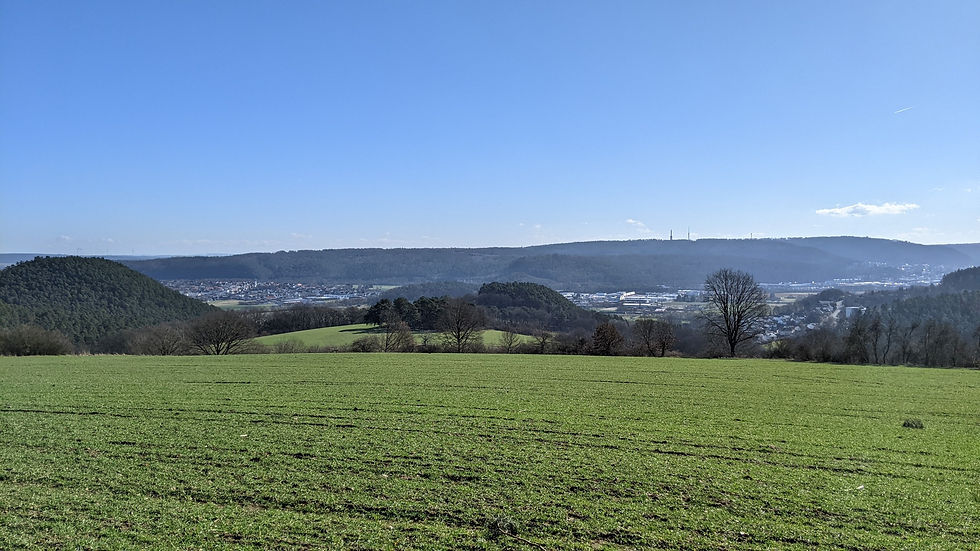
The first stretch is quiet and gentle: a paved farm road across open fields, with the hills slowly getting closer. The Lahnwanderweg was built with a lot of work and pride by the people who live along it, and these early kilometers are an easy way to settle into the day. Somewhere along the way we crossed a creek on a stone bridge with several arches, and farther on the view opened up over green fields toward a distant valley.

The Weißenstein
About halfway through the stage there is a short detour up to the ruins of Burg Weißenstein. The official trail page describes the ruin as sitting on a hilltop of light-colored sandstone, about 260 meters up. Not much is left but walls, but the signs up there more than make up for it.


The best one is titled "Die Burg Weißenstein in Sage und Märchen": Sage means "legend" and Märchen means "fairy tale" (literally a "little tale"). It is a good one.

According to the sign, a cruel knight named Kuno lived on the Weißenstein and tormented the villagers of Wehrda and the surrounding villages with taxes, tithes and forced labor. When a young man from Wehrda shot a deer, he was caught, branded on the cheek with a poacher's antler and whipped out the gate. The villagers knew the knight's great passion was the Schwertertanz ("sword dance"), so they asked permission to perform it in the castle. Then they attacked, killed the knight and his men and destroyed the castle.
The knight's noble daughter threw her goldenes Spinnrad ("golden spinning wheel") and other treasures down the slope into the Lahn. Every seven years it rises from the bottom, and whoever has luck can pull it out. The sign has a second story about a giant named Essel, who lived on the Weißenstein and threw the goldenes Burgtor ("golden castle gate") into the Lahn near a field called the Esselswerd (a Werd is a river island). Two fishermen once snagged it, and one of them shouted "Halb Part!" ("half share!"). The gate sank and was never seen again. The sign credits Emil Schneider's Hessisches Sagenbuch, and it also shows an illustration by Otto Ubbelohde for the Grimm fairy tale Sterntaler ("star coin") with the Weißenstein in the background.
Also on the stage is the Teufelsgraben ("devil's ditch"), a nature protection area that the trail passes through, and the official page lists the Emil von Behring Mausoleum as a highlight. We missed it this time, but it comes up in a later post. Behring developed the diphtheria serum around 1890 and received the very first Nobel Prize in Physiology or Medicine in 1901. He worked in Marburg from 1895 and founded the Behring-Werke there.
Down into Marburg
The last part was my favorite: forest paths with stone steps, and then the first view of Marburg's old town and the castle on the hill above it.


Marburg was first mentioned in 822, and by about 1140 the Landgraves of Thuringia controlled it. In 1228 Elizabeth of Hungary made it her home as a widow. She died there in 1231 at just 24 and was canonized in 1235. From 1264 until about 1540 it was one of the capitals of Hesse, and in 1527 the University of Marburg was founded, the oldest existing university in the world founded as a Protestant one. Two years later Luther and Zwingli argued about communion here in the Marburg Colloquy of 1529. The Brothers Grimm studied and collected fairy tales here in the early 1800s, which fits nicely with the Märchen we had just read on the mountain.

That is Ethan in front of the Elisabethkirche (St. Elizabeth's Church), which Elizabeth's own story built. She founded a hospital in Marburg in 1228 and was buried in its chapel after her death in 1231. In 1234 the hospital passed to the Teutonic Knights, and work on the church began in 1235. It was consecrated in 1283, and the two towers, about 80 meters tall, were finished by 1340. It is one of the earliest purely Gothic churches in German-speaking lands and served as a model for Cologne Cathedral, which we climbed in the Köln post. The Landgraves of Hesse were buried in its choir between 1240 and 1509.

The animal heads sticking out of the stone wall on the Steinweg are part of the Grimm-Dich-Pfad, a fairy-tale trail with 15 stations scattered around the old town. This one is station 2, "Der Wolf und die 7 jungen Geißlein" ("The Wolf and the Seven Young Kids"; a Geißlein is a little goat), and it is the wolf and one of the kids looking out at you from the wall.
The Numbers
According to our recording it was 9.74 miles with 1,749 feet of climbing. We were moving for 3 hours 47 minutes and were out there about 4 hours total. The official page lists the stage at 15.9 km and about 5 hours 15 minutes, so we kept a good pace. If you want to do it yourself, here is the stage on AllTrails. Stage 5 is here.
Possum et ego.


Comments