
The Harz, Part III: Lost and Orange

The third day was the big hike. We did a trail called Zum Ottofelsen und der Grenzklippe ("To the Otto Rock and the Border Cliff"; a Klippe is a cliff and Grenze is a border), and it ended up being the most memorable day of the trip. AllTrails lists it as an 11.3 mile (18.2 km) loop with about 1,702 feet of climbing, rated hard, and I'd agree with the hard part.
The Old Oak

First we passed an enormous old oak with a fence around it. It looks like the Hohne-Eiche, a sessile oak (a Traubeneiche, "grape oak", named for the way its acorns cluster) on the Hohnewiese meadow near Drei Annen Hohne. It is over 500 years old with a trunk more than five meters around, and in 2025 it was named a Nationalerbe-Baum, a "national heritage tree", one of 100 such trees in Germany. Trees that old are very rare here. A tree biologist quoted in the news said it is stable and could live several more decades, though it looked rough when we saw it, hollow and split open.


Granite
The Harz is granite country, and the rocks here are strange and wonderful. This stretch of the trail was full of huge boulders, steel staircases and railings, and viewpoints.



A Forest That Died
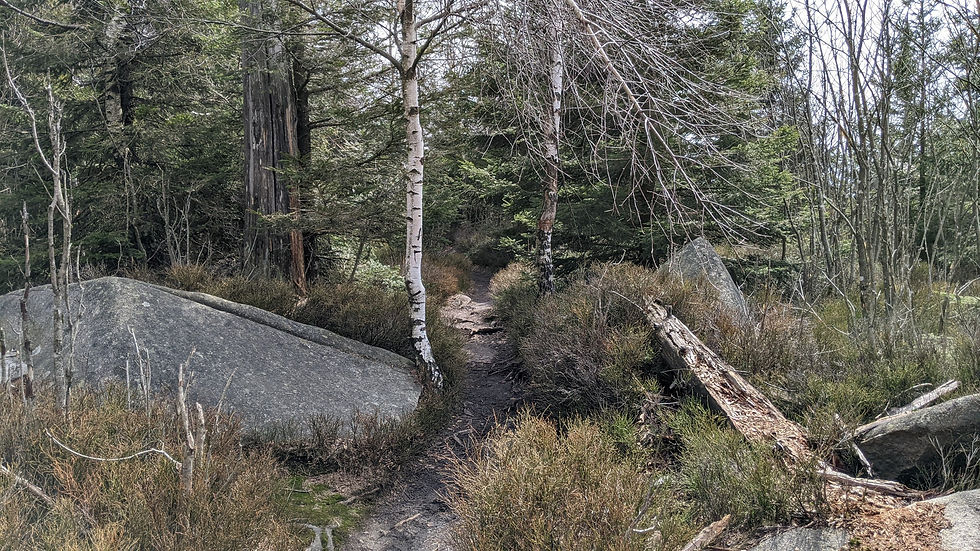
What shocked me most was the forest. A huge amount of the spruce is dead. In Harz National Park about 90 percent of the original spruce has died. The drought from 2018 to 2020 was the most extreme in Germany in 250 years, and it weakened the trees until they couldn't make enough resin to defend themselves. Then the bark beetles finished them off, mainly Ips typographus (the "eight-toothed spruce bark beetle"). Spruce was planted across the Harz from the Middle Ages on, and over 80 percent of the old stand was spruce, although it naturally grows mainly above 700 meters, where few Harz areas lie.


The park's approach is to let nature take its course. Foxglove, fireweed, rowan and birch are already coming back, and over the next 50 to 70 years it is expected to become a mixed forest of spruce, maple and beech. It was still a strange thing to hike through. And it nearly got us in trouble. On the hillside going down, half the forest had been knocked down, the trail disappeared below the fallen trees, and we almost got lost.


Stones with Names

The sign on the tree says Naturdenkmal Gebohrter Stein. A Naturdenkmal is a "natural monument", a protected natural feature, and the Gebohrter Stein is the "bored stone" or "drilled stone". The sign says it shows the characteristic Wollsack ("woolsack") weathering of Harz granite, protected since 1964, and that is a good description. The granite splits into big rounded blocks that look like sacks of wool stacked on top of each other.


The trail is named for the Ottofelsen, a 36 meter granite rock named for Prince Otto of Stolberg-Wernigerode, the same Otto who rebuilt the castle in Part II. Iron ladders lead to the top, and they were first opened in a ceremony on July 27, 1892. They were replaced after 1990. The view from the summit takes in the Brocken and the northern edge of the Harz.
The Orange Inn
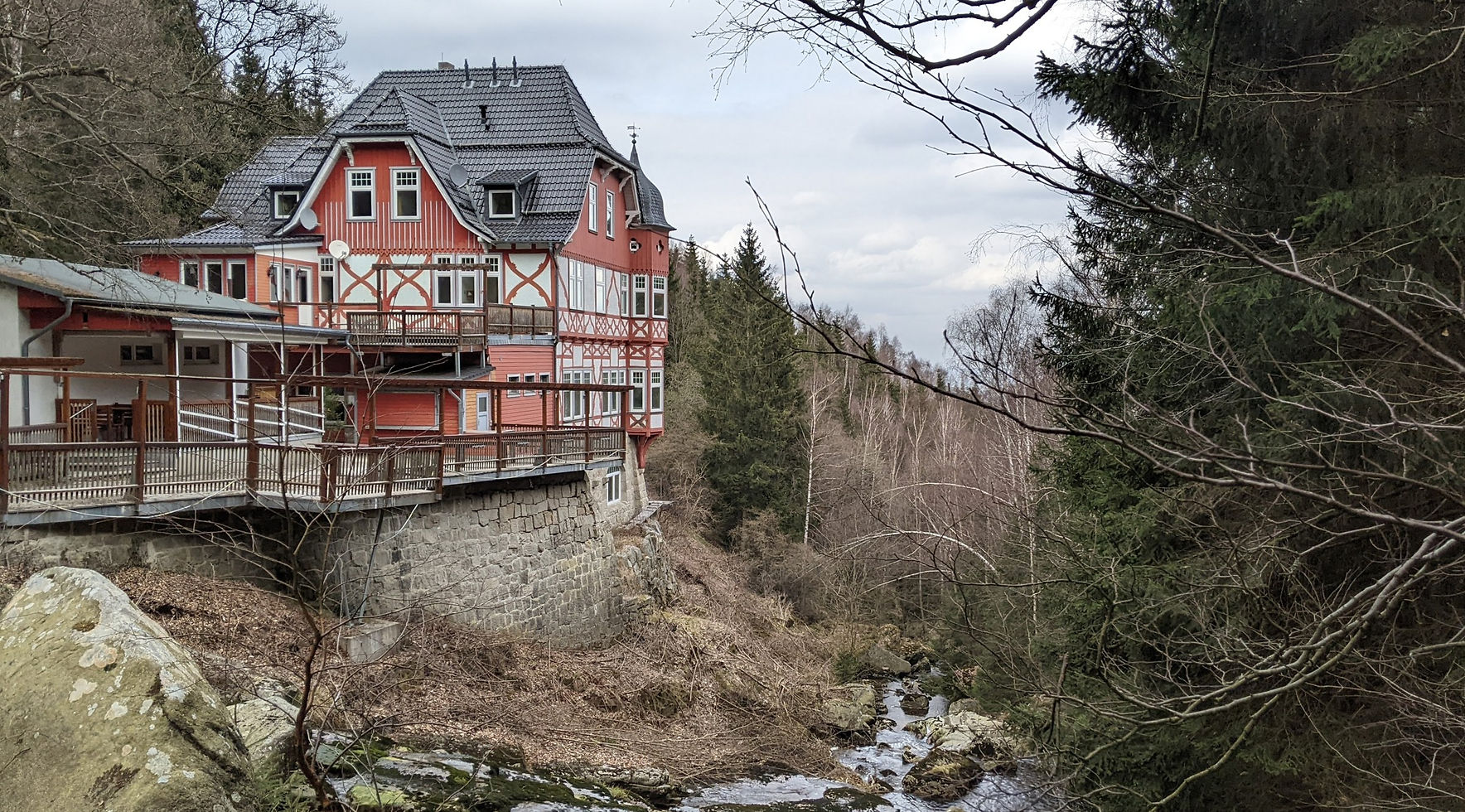
The most interesting stop was the Berghotel Steinerne Renne ("mountain hotel"), the orange half-timbered inn perched above a stream. The Steinerne Renne is a cascade on the upper Holtemme river, a series of little waterfalls and rapids over boulders that drops about 250 meters from top to bottom. The name is old, recorded in the early modern period as Steinrenne or steinerne Rinne, which means "stone channel".


The first building here was a log cabin built right beside the waterfall in 1869, and it is the predecessor of the present hotel. Tourism boomed in the mid-1800s and this became one of the most popular scenic spots in the Harz. When the Harz railways were built, a station was added just for it, and it is still there. After the war, the site was in East Germany, and the building was run as a state-owned pub until the mid-1970s. It was then converted into a works holiday home with a public restaurant. Today it is stop number 28 in the Harzer Wandernadel, the Harz hiking-pin stamp network, and it is back to being a hotel and a place to eat.
The gorge itself is about 2.5 km of the Holtemme valley, a protected natural monument where the river, which rises on the Brocken massif, has cut its way through granite over millions of years. The inn sits above it at about 520 meters. There is even a steel engraving from around 1855, in Brückner's Harz-Album, showing the cascade with a couple of pairs of tourists admiring it, so people were coming here to see it long before we did. Farther down the valley, a hydropower plant opened in 1899 to power the gravel and granite works that operated here, and the town of Wernigerode has run it as a technical monument since 2002. I never got to the bottom of the inn's own story, so if anyone knows more, let me know.
That was a long, tough, beautiful day. Possum et ego.


Comments