
Lorchhausen on the Rhine


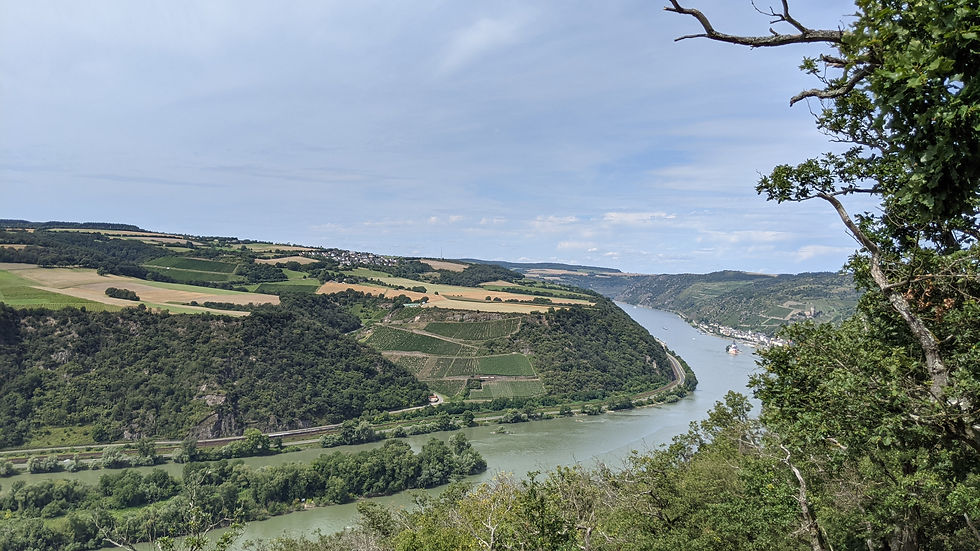
There is something about every visit to the Rhine Valley which always seems to be magical. This trip was no different, as I found my self pondering how long this village has been located here and anxious to see what was sure to be another spectacular view of the river valley. Ellie's parents were staying with us and joined us for the trip. We nervously made our way into the village, all crammed inside our huge American Mazda CX-9 and finally found parking on a hill at the base of our climb, leading through the stations of the cross and up to the Clemens Chapel at the top of the ridge.
Translated from the web https://heilig-kreuz-rheingau.de/beitrag/geschichte-der-kirche-st-bonifatius-und-der-clemenskapelle/
"The Clemens Chapel, built in 1909, looks out between the vineyards and the forest above, from which the beautiful view over the village and the Rhine lowland is particularly impressive.
The Clemens Chapel, named after Pastor Clemens La Roche who initiated its construction, was built in tribute to the "Mother of Sorrows" based on designs by architect Georg Hartmann from Geisenheim. Constructed with local quarry stone, the chapel harmoniously blends into the landscape above Lorchhausen. Visitors ascending the Calvary, adorned with the 1870 Stations of the Cross, are treated to a magnificent view of the village.
Heinrich Nies, a resident of Lorchhausen born in 1827, conceived the idea of creating the path with 14 stations. The Way of the Cross was officially opened on the Feast of the Exaltation of the Cross in 1870, culminating at the Clemens Chapel. The Stations of the Cross, characterized by brick facades and slate roofs, feature colorful relief images depicting the suffering of Jesus Christ in pointed arched niches. These images, sourced from the parish church, replaced the original reliefs in 1961 due to their deteriorating condition. The chapel's altar showcases a crucifixion group.
In 2009, the community marked the chapel's centenary with a church service and a celebratory event on Calvary. The recitation of the Stations of the Cross takes place twice a year during the pilgrimage to the chapel.
Further along the trail, as we ventured deeper into the dense woods, our curiosity led us to stumble upon a mysterious structure that appeared to be some sort of bunker. Its weathered exterior and the way it seemed integrated into the natural cave formations hinted at a long history shrouded in secrecy. Despite our attempts to gain access, the entrance was securely fortified, leaving us only able to lift a couple of the children up to catch a glimpse of the interior. Their faces lit up with a mix of awe and wonder as they peered down into the darkness below, their imaginations running wild with possibilities.


As we stood there, contemplating the purpose of this enigmatic bunker, various theories swirled in our minds. The thought that it could be a remnant from the era of World War II lingered in our thoughts, evoking images of clandestine operations and hidden wartime activities. The idea that it might have served as a shelter, a storage facility, or even a lookout point during turbulent times added layers of intrigue to our discovery.
Despite the lack of concrete answers, the allure of the bunker's mystery lingered in our minds long after we left it behind on the trail. It served as a reminder of the hidden stories woven into the fabric of the landscape, waiting to be unraveled by those willing to explore and imagine the secrets of the past.
Even further down the trail, we discovered yet another castle or fort tucked away on private land. It was surrounded by a fence and signs that said private property and this just made it even more alluring, but we kept our distance in line with the owner's wishes.
All in all a good trail and recommended. It gets hot up there in the summer, so be sure to bring water. Here is a link to trails in the area. Feel free to explore this or any of the many other trails in the area.
Until next time...

Comments